“再/现”——第六届FUTURELAB艺术与设计创新教育博览会
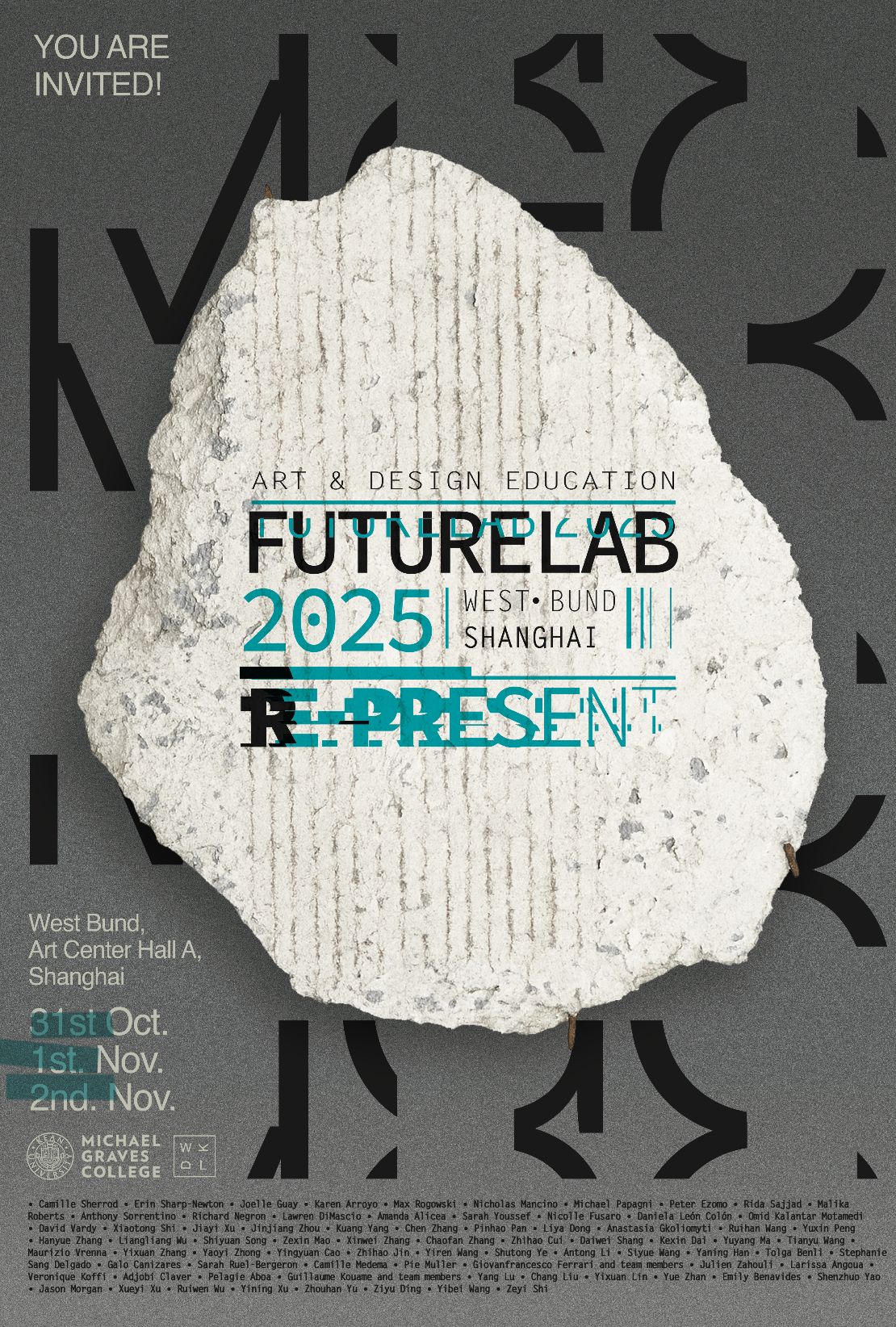 再/现(Re-Present)
温州肯恩大学 & 美国肯恩大学迈克尔格雷夫斯学院联展
第六届Futurelab艺术与设计创新未来教育博览会
上海西岸艺术中心
2025.10.31 – 2025.11.2
联合策展人:刘唱、奥米德·卡兰塔·莫塔梅迪、大卫·瓦尔迪、史晓桐
策展缘起:从一堆废料开始
“再/现”的起点,是一次偶然的注视。
在温州肯恩大学建筑与设计学院的工坊里,堆放着许多被遗忘的材料——施工留下的木料边角、废弃的金属碎片、过期的展览物料、甚至订书机盒和空瓶子。它们等待着被清运,成为“垃圾”。
我们决定:不买任何新材料,就用这些即将被丢弃的东西,搭建一个展览。
这个决定,成为“再/现”最核心的策展理念——让循环设计不再是一个抽象的概念,而是一场可以被触摸、被看见的实践。从纸浆制作的展签到废弃木料搭建的展台,从往届展板改造的介绍牌到回收材料构成的装置作品,整个展区本身就是一件“再生之作”。
正如我在接受澎湃新闻采访时所说:“我们不介意这些材料上看似‘脏’的印记,这些痕迹记录了它们过去的生命,而未来它们还会在不同场域延续价值,这就是循环与可持续的体现。”
策展理念:循环作为方法
“present”意味着呈现——某物代表或象征他物。而“再/现”远不止于简单的复制。它是新旧之间的对话——对理念、材料、场域的不断回归,将既存之物转化为新生之态。
循环设计是一个四维的概念。它不仅包含时间、历史和记忆,更强调在设计教育中,唯一不变的是其与时俱进的相关性——而这种相关性,正是通过学科的不断重构与创新来实现的。
本次展览聚焦中美两国(全球两大城市废弃物生产国)共同关注的废弃物利用议题,首次邀请美国肯恩大学师生共同创作。通过图形与雕塑艺术、交互设计、新型工具及算法流程等多种形式,我们将废弃物转化为兼具艺术价值与实用功能的作品,展现两国师生应对废弃物难题的设计智慧。
策展实践:从理念到落地
作为策展人,我与奥米德·卡兰塔·莫塔梅迪、大卫·瓦尔迪、史晓桐共同完成了从概念构思到现场搭建的全过程。
材料的选择是一次考古式的发掘。我们从学院大楼的施工废料中逐一挑选可用之材——那些被丢弃的木料上还留着钉孔和水泥渍迹,金属碎片带着锈蚀的痕迹,纸板箱压扁后堆在角落。我们没有试图掩盖它们的“过去”,而是让这些痕迹成为展览叙事的一部分。
空间的营造回应着“循环”的主题。白色纱帘围合出一个圆形展区,光影投射下,废弃材料透出别样的质感。展品基座由拼合的废木板和金属碎片构成,斑驳的表面记录着它们曾经的用途——每一件基座,都是一段沉默的物质史。
作品的整合跨越了中美两校。美国肯恩大学师生的《小心轻放》《24½世纪的建筑规范》《健康共同行动》三组作品纳入展区,三名建筑学研究生交换生更亲赴上海,参与了现场策划与搭建。这场合作历时两个多月,跨时区的线上会议、密集的微信沟通,最终将相隔太平洋的创作汇聚于同一空间。
参展作品
展区内呈现的10组作品,每组都践行着“旧物新生”的核心理念:
《重拾现实》(Omid Kalantar Motamedi指导)
以校园内的竹枝、木材、金属、快递袋等日常废弃物为素材。“愿望之树”用回收铁锯片与木材打造,象征人与自然和谐共处的愿景;全息投影的“凤凰”从“废料灰烬”中浴火重生,直观传递旧物新生的魅力。
《记录八十年》(WKDL、David Vardy指导)
以温州市实验中学淘汰的旧课桌椅为原料,经计算设计与机器人手臂搭建。这些带着学生笔迹、边缘磨得发亮的桌椅,蜕变为纪念该校80周年的立体装置。每一列木条标注的年份(1944-2024),长度对应班级人数,曲线反映教师数量与校区增长——旧物在此成为时间的见证者。
《涟》(卢阳创作,大三视觉传达学生)
实时互动作品,通过Touch Designer编程捕捉观众影像,在人像周围生成印满垃圾的碎片效果。创作者卢阳的灵感来自新疆旅行时目睹的垃圾污染——平静海面与漂浮垃圾的反差,隐喻人类活动对自然的影响。这件作品从课堂走向展场,让我看到教学与创作相互滋养的可能。
《小心轻放》(美国肯恩大学)
聚焦3D打印过程中的材料浪费,探讨数字制造时代的循环可能。
《24½ 世纪的建筑规范》(美国肯恩大学)
构想未来城市靠人与自然、人与人互相包容形成的建筑规则。
《大海》
用环保胶水将零碎废木块粘合,手工雕成灵动的海马。
《健康共同行动:科特迪瓦的可持续登革热防控》(美国肯恩大学)
以设计赋能公共健康,用低成本材料助力登革热防控。
《共振》
将废弃材料与数字投影、传统元素融合,探索旧材料的新表达。
《投影上望》
扎根瑞安上望城中村,让设计贴近真实需求。
《现代竹镶》
对传统工艺进行重构,在文化层面实现工艺精神的再生。
现场回响
展览期间,“再/现”展区吸引了大量观众驻足。澎湃新闻在报道中特别提及我们的策展理念,将其作为本届FutureLab“直面社会议题”的典型案例。
温州肯恩大学设计系主任黄瑶瑶评价道:“学生全程参与展览的设计、制作与搭建,这种实践可以使他们跳出课堂,通过设计去探索现实问题。”
《涟》的创作者卢阳的感言让我尤为触动:“我和设计实验室的同学,还有美国肯恩大学的交换生一起,花了四天时间搭建整个展区。从实践中学到的知识,比书本上的理论丰富得多。”
美国肯恩大学与温州肯恩大学建筑与设计学院副院长Rose Gonnella也对此次合作给予充分肯定:“中美肯恩师生共同参与此次展览,为两校未来的教学工作和合作开辟了令人振奋的新方向。”
策展后记
“再/现”的搭建材料,大多来自学院工坊的施工废料。撤展后,它们将被拆解回收,用于下一次展览。
这意味着,这个展览从诞生的那一刻起,就在为它的“来世”做准备。那些木料、金属、纸板,会在未来的某个空间里再次被拾起,再次被重组,再次被赋予新的意义。
循环,不是一次性的姿态,而是持续的承诺。作为策展人,我希望“再/现”不仅是关于循环的展览,它本身就是一个循环的参与者——在不断的“再/现”中,完成自己的再生。
展览信息
展览:再/现(Re-Present)
参展院校:温州肯恩大学迈克尔格雷夫斯建筑与设计学院、美国肯恩大学迈克尔格雷夫斯学院
地点:上海西岸艺术中心A馆
展期:2025年10月31日 – 11月2日
联合策展人:奥米德·卡兰塔·莫塔梅迪(Omid Kalantar Motamedi)、刘唱(Chang Liu)、大卫·瓦尔迪(David Vardy)、史晓桐(Xiaotong Shi)
项目负责人:林祎萱(Yixuan Lin)
展览设计:温州肯恩设计实验室(WKDL)
参与师生:中美肯恩80余位师生
Re-Present
Wenzhou-Kean University & Michael Graves College, Kean University Joint Exhibition
The 6th FutureLab Art and Design Innovation Education Expo
West Bund Art Center, Shanghai
October 31 – November 2, 2025
Co-Curators: Liu Chang, Omid Kalantar Motamedi, David Vardy, Shi Xiaotong
Curatorial Origin: Starting from a Pile of Waste
Re-Present began with a moment of noticing.
In the workshops of the Michael Graves College of Architecture and Design at Wenzhou-Kean University, forgotten materials accumulated—wood scraps left from construction, discarded metal fragments, expired exhibition supplies, even stapler boxes and empty bottles. They awaited disposal, destined to become "trash."
We made a decision: purchase no new materials. Build an exhibition using only what was about to be thrown away.
This decision became the core curatorial理念 of Re-Present—not as an abstract concept, but as a tangible, visible practice. From展签 made of paper pulp to display platforms constructed from废弃木材, from introduction panels repurposed from previous exhibitions to installations assembled from recycled materials, the entire exhibition space became a work of再生 itself.
As I shared in an interview with The Paper: "We don't mind the seemingly 'dirty' marks on these materials. These traces record their past lives. In the future, they will continue to hold value in different contexts—this is the embodiment of循环 and sustainability."
Curatorial Concept: Circularity as Method
"Present" means to show—something that stands for or represents something else. Yet Re-Present goes far beyond simple replication. It is a dialogue between old and new—a continuous return to ideas, materials, and sites, transforming what already exists into something新生.
Circular design is a four-dimensional concept. It encompasses not only time, history, and memory, but also emphasizes that in design education, the only constant is its evolving relevance—a relevance achieved precisely through the continuous reconstruction and innovation of the discipline itself.
This exhibition聚焦 on waste utilization, an issue of shared concern to China and the United States—the world's two largest producers of urban waste. For the first time, we invited faculty and students from Kean University to collaborate. Through graphic and sculptural art, interactive design, new tools, and algorithmic processes, we transformed废弃物 into works of both artistic value and practical function, showcasing the design wisdom of both nations in addressing the challenge of waste.
Curatorial Practice: From Concept to Reality
As curators, Omid Kalantar Motamedi, David Vardy, Shi Xiaotong, and I共同完成了从概念构思到现场搭建的全过程。
Material selection became an archaeological excavation. We逐一挑选可用之材 from the construction waste of our college building—wood scraps still bearing nail holes and cement stains, metal fragments with traces of rust, cardboard boxes flattened and stacked in corners. We made no attempt to掩盖 their "past"; instead, these traces became part of the exhibition's narrative.
Spatial design responded to the theme of循环. White纱帘 enclosed a circular exhibition area, where光影投射 gave废弃材料 an unexpected texture. Display pedestals were assembled from拼合的废木板 and metal fragments, their mottled surfaces recording their former用途—each pedestal, a silent material history.
Work integration spanned across both institutions. Three works from Kean University—Handle with Care, Architectural Codes for 24½ Century, and 共同行动: Sustainable Dengue Prevention in Côte d'Ivoire—were included, with three graduate architecture exchange students participating on-site in planning and installation. This collaboration spanned over two months, navigating跨时区线上会议 and密集微信沟通, ultimately bringing together creations from across the Pacific in a single space.
Exhibited Works
The ten works presented in the exhibition each embodied the core concept of "old materials新生":
Reclaiming Reality (guided by Omid Kalantar Motamedi)
Created from everyday废弃物 collected on campus—bamboo branches, wood, metal,快递袋. The "Wishing Tree," constructed from recycled saw blades and wood, symbolizes harmonious coexistence between humans and nature. A holographic "phoenix" rises from the "ashes of waste," intuitively conveying the魅力 of旧物新生.
Recording Eighty Years (WKDL, guided by David Vardy)
Using discarded desks and chairs from Wenzhou Experimental Middle School, this installation was constructed through computational design and robotic assembly. These desks and chairs, bearing students' handwriting and edges worn smooth by use, were transformed into a three-dimensional installation commemorating the school's 80th anniversary. Each wooden strip标记着年份 (1944-2024), its length corresponding to class size, its curves reflecting faculty growth and campus expansion—old objects became witnesses to time.
Ripple (created by Lu Yang, third-year Visual Communication student)
An interactive real-time work using Touch Designer to capture观众影像, generating fragmented effects printed with garbage imagery around the viewer's likeness. Creator Lu Yang's inspiration came from witnessing pollution during a trip to Xinjiang—the contrast between平静海面 and floating waste隐喻着人类活动对自然的影响. This work, born from the classroom and brought to the exhibition, showed me the mutually nourishing relationship between teaching and creation.
Handle with Care (Kean University)
Focusing on material waste in 3D printing, exploring possibilities for循环 in the age of digital manufacturing.
Architectural Codes for 24½ Century (Kean University)
Imagining future cities shaped by rules of包容 between humans and nature, and among humans themselves.
The Sea
Using环保胶水 to bond fragmented废木块, hand-carved into a灵动 seahorse.
共同行动: Sustainable Dengue Prevention in Côte d'Ivoire (Kean University)
Empowering public health through design, supporting dengue prevention with low-cost materials.
Resonance
Integrating废弃材料 with digital projection and traditional elements, exploring new expressions for old materials.
Gazing from Shangwang
Rooted in the urban village of Shangwang, Rui'an, bringing design closer to真实 needs.
Modern Bamboo Inlay
Reconstructing traditional craftsmanship, realizing the再生 of工艺精神 at a cultural level.
On-Site Response
During the exhibition, the Re-Present section attracted numerous visitors. The Paper特别提及 our curatorial理念 in their coverage, citing it as a典型案例 of this FutureLab "confronting social issues."
Huang Yaoyao, Head of the Design Department at Wenzhou-Kean University, observed: "Students participated throughout the entire process of exhibition design, production, and installation. This practice allows them to step beyond the classroom and explore real-world problems through design."
The words of Lu Yang, creator of Ripple, moved me deeply: "I spent four days building the exhibition alongside classmates from the Design Lab and exchange students from Kean University. What I learned through practice is far richer than what I could gain from书本理论 alone."
Rose Gonnella, Associate Dean of the Michael Graves College at both Kean University and Wenzhou-Kean University, affirmed the collaboration: "The participation of faculty and students from both Chinese and American campuses in this exhibition opens exciting new directions for future teaching and cooperation between our institutions."
Curatorial Afterword
The materials used to build Re-Present came largely from construction waste in our college workshops. After the exhibition closes, they will be disassembled and回收, used for future exhibitions.
This means that from the moment it was born, this exhibition was preparing for its "afterlife." Those pieces of wood, metal, and cardboard will one day be picked up again in another space, reassembled,赋予新的意义.
Circularity is not a one-time gesture, but an ongoing commitment. As a curator, I hope that Re-Present is not merely an exhibition about循环—it is itself a participant in循环, continuously completing its own再生 through successive acts of "re-presentation."
Exhibition Information
Exhibition: Re-Present
Participating Institutions: Michael Graves College of Architecture and Design, Wenzhou-Kean University; Michael Graves College, Kean University
Venue: West Bund Art Center Hall A, Shanghai
Duration: October 31 – November 2, 2025
Co-Curators: Omid Kalantar Motamedi, Liu Chang, David Vardy, Shi Xiaotong
Project Lead: Yixuan Lin
Exhibition Design: Wenzhou-Kean Design Lab (WKDL)
Participating Faculty and Students: Over 80 from Wenzhou-Kean and Kean Universities