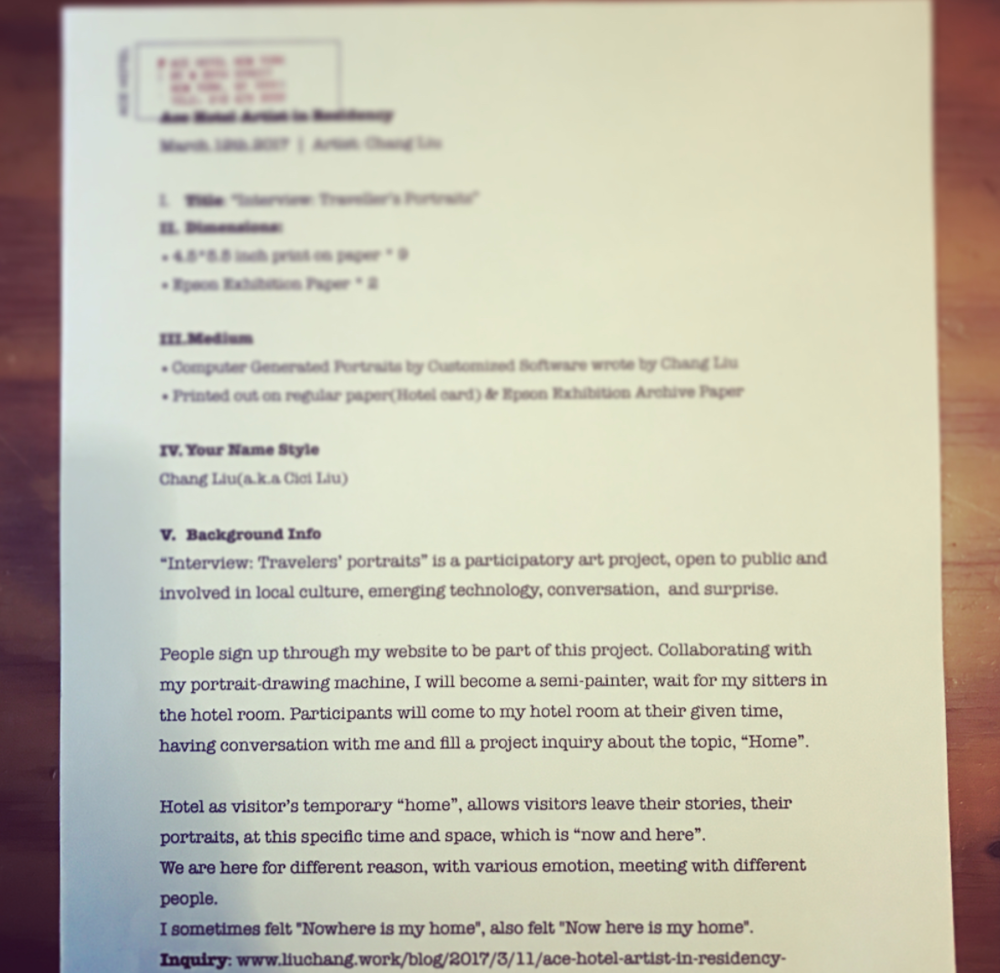
Artist Residency:
ACE HOTEL AIR Program
艺术家驻留项目:纽约 ACE HOTEL“一天”项目
 《随机漫步者:旅人肖像》
艺术家驻地项目,公共艺术项目,Ace Hotel AIR驻地计划
21小时,一间酒店客房,一台运行着算法的电脑,一场又一场的对话。
2017年3月12日下午3点至次日正午,艺术家刘唱在Ace Hotel完成了一次可能是“世界上最短的驻地项目”。她将酒店房间临时改造为一间流动肖像工作室,邀请旅人预约30分钟的时段——静坐,交谈,然后被一台运行着“随机漫步者”算法的机器画下来。 驻地语境:Ace AIR与创意社群的相遇
Ace Hotel的艺术家驻地项目(A.I.R.,即Artist in Residence)自2014年启动以来,已成为酒店品牌与创意社群深度连接的标志性项目。其理念简单而开放:艺术家获得一晚住宿、少量津贴和一间可以自由使用的房间,唯一的要求是“做任何你想做的事——只要不打扰客人、不损坏财产”。这种极低的门槛和高度的信任,催生了无数即兴的、偶发的、不可复制的创作——从漂浮的氦气球到psychedelic视频投影,从诗歌到食谱,从音乐到纸牌游戏。
Ace Hotel将艺术家驻地视为“提供思考的时间和创作的空间”。在纽约、洛杉矶、棕榈泉、伦敦等城市的分店,酒店与当地的策展团体、文化机构合作,邀请艺术家将客房转变为临时工作室,并在驻留结束后与社区分享成果。正如Ace Hotel合伙人Kelly Sawdon所言:“这些艺术家探讨的话题——绅士化、劳动、性别认同、公平——我们很荣幸能让这些沉浸式的对话在我们的空间中流动。” 项目的双重仪式:对话与“随机漫步者”
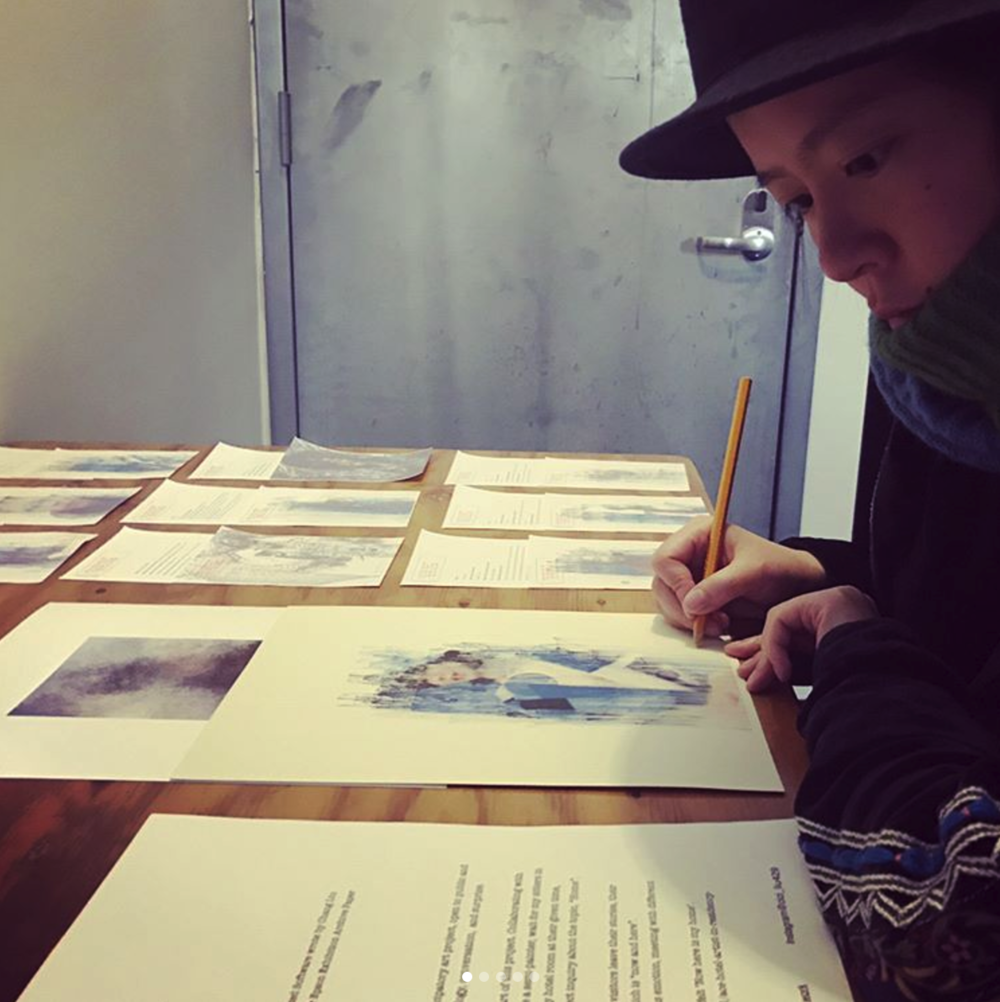
《随机漫步者:旅人肖像》将驻地空间转化为一场关于“相遇”的仪式。每一位参与者需提前预约一个30分钟的时段。在这半小时里,两件事同时发生:一是与艺术家的随意交谈,二是静坐等待自己被“画”下来。
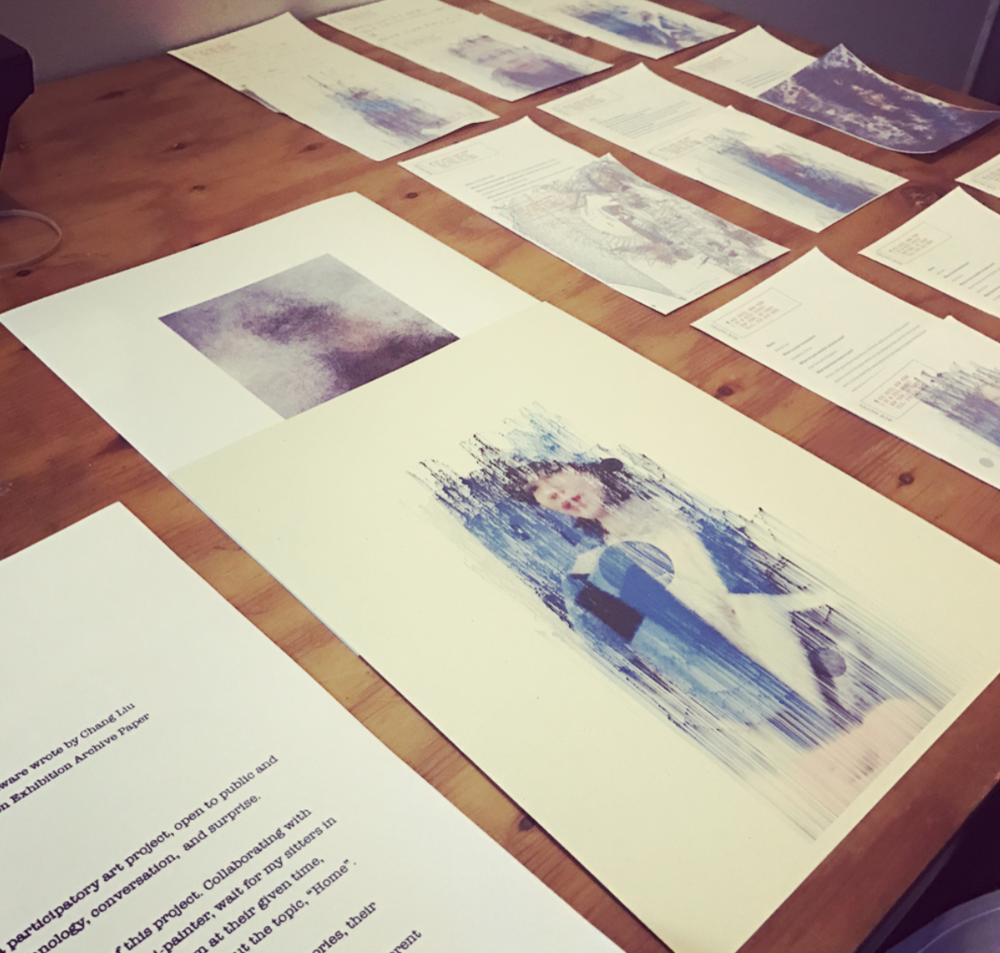
这里的“画”是刘唱“闪烁的存在”系列的核心方法论——摄像头成为“画家的眼睛”,随机漫步者算法成为“画家的笔刷”。与以往展览空间中的呈现不同,这一次,算法被带入一个临时性的酒店房间,它所面对的“模特”不是偶然经过的观众,而是主动预约的旅人。他们在旅途中的短暂停留,被算法转化为一幅幅抽象肖像。
与传统肖像画中被动静默的模特不同,在这里,旅人成为与算法共同创作的合作者。他们可以静静坐着,看自己的轮廓缓慢浮现;而算法的每一次运行,都是一次即兴的生成——不可预测,不可复制。
机器的介入使整个过程带上了一层微妙的陌生感:它是观察者,也是记录者;是工具,也是共谋。而对话则让这场观察不再是单向的凝视,而成为双向的交流。这种设置呼应了Ace AIR项目所珍视的“沉浸式对话”精神。在酒店这个临时居所的空间里,旅人、艺术家、算法之间形成了一种短暂而亲密的三角关系。每一场对话都是一次微型的交换,每一幅肖像都是一次相遇的证明。 “随机漫步者”系列的一次特殊迁移
这是“随机漫步者”系列第一次离开传统的展览空间,进入一个更具临时性和日常感的场域。在画廊或美术馆中,观众与作品的关系往往是短暂而匿名的;而在Ace Hotel的驻地中,关系被重构了:
- 时间被拉长:30分钟的时段,让算法创作成为一个可以观看、可以等待的过程
- 空间被私有化:酒店房间的私密性,改变了观看与被观看的权力关系
- 身份被聚焦:每一位参与者都是主动预约的旅人,他们的故事和停留,成为肖像的一部分
21小时,在Ace AIR项目数百次驻留中,或许是最短的一次。但“短”本身也成为意义的一部分——它让创作回归到最核心的动作:观察、交谈、记录。没有过多的准备,没有冗余的环节,只有一个艺术家、一台运行着算法的电脑、一群恰好在此刻经过的旅人。
正如刘唱在“闪烁的存在”系列中所言:“时光流逝,不留痕迹。但艺术作品,让那些闪烁的存在被看见——即便只是刹那。”在Ace Hotel的21小时里,算法捕捉了那些短暂停留的旅人,将他们此刻的存在凝固为一幅幅永不重复的肖像。
正如Ace Hotel所相信的那样:“如果你以一种艺术的方式去做任何事,那它就是艺术。”《随机漫步者:旅人肖像》用21小时证明:艺术的发生,有时只需要一间房间、一个下午、一台运行着算法的电脑,和一个愿意坐下来被看见的人。 项目信息
艺术家:刘唱
系列:“闪烁的存在”
驻地项目: Ace AIR (Ace Hotel Artist in Residence Program)
地点:Ace Hotel
时间:2017年3月12日 15:00 – 3月13日 12:00
形式:公共艺术项目,一对一肖像绘画预约
每时段:约30分钟
媒介:计算机生成绘画(随机漫步者算法),对话访谈
 Random Walker: Traveller's Portraits
Public Art Project, Ace Hotel AIR Residency
21 hours, a hotel room, a computer running algorithms, and a series of conversations.
From 3 PM on March 12 to noon the following day in 2017, artist Liu Chang completed what might be the "world's shortest residency" at Ace Hotel. She transformed the hotel room into a temporary portrait studio, inviting travelers to book 30-minute slots—to sit still, converse, and then be "drawn" by a machine running the Random Walker algorithm. The Residency Context: Ace AIR and the Creative Community
Since its launch in 2014, Ace Hotel's Artist in Residence (A.I.R.) program has become an iconic initiative connecting the hotel brand with the creative community. The concept is simple and open-ended: artists receive a one-night stay, a small stipend, and a room they can use freely. The only requirement is "do whatever you want—as long as you don't disturb the guests or damage the property." This low threshold and high level of trust have spawned countless spontaneous, serendipitous, and unrepeatable creations—from floating helium balloons to psychedelic video projections, from poetry to recipes, from music to card games.
Ace Hotel views artist residencies as a way to "provide time to think and space to create." Across locations in New York, Los Angeles, Palm Springs, London, and other cities, the hotel collaborates with local curatorial groups and cultural institutions, inviting artists to transform guest rooms into temporary studios and share their outcomes with the community after the residency. As Ace Hotel partner Kelly Sawdon puts it: "The topics these artists explore—gentrification, labor, gender identity, equity—we're honored to have these immersive conversations flow through our spaces." The Project's Dual Ritual: Conversation and the Random Walker
Random Walker: Traveller's Portraits transformed the residency space into a ritual of encounter. Each participant booked a 30-minute slot in advance. During this half-hour, two things happened simultaneously: a casual conversation with the artist, and the act of sitting still while being "drawn."
The "drawing" here represents the core methodology of Liu Chang's Flickering Existence series—the camera serves as the "painter's eyes," while the Random Walker algorithm acts as the "painter's brush." Unlike its presentation in traditional exhibition spaces, this iteration brought the algorithm into a temporary hotel room, where its "subjects" were not accidental passersby but travelers who actively booked a session. Their brief pause during their journey was transformed into abstract portraits by the algorithm.
In contrast to the passive, silent sitter of traditional portraiture, here the traveler becomes a co-creator working alongside the algorithm. They can sit quietly and watch their likeness slowly emerge; each run of the algorithm is an improvisational generation—unpredictable, unrepeatable.
The machine's介入 introduces a layer of subtle unfamiliarity to the process: it is observer and recorder, tool and accomplice. The conversation, meanwhile, ensures that this observation is not a one-way gaze but a two-way exchange. This setup echoes the immersive conversation spirit valued by the Ace AIR project. Within the temporary, intimate setting of a hotel room, a brief, intimate triangle forms between traveler, artist, and algorithm. Each conversation is a miniature exchange; each portrait is proof of an encounter. Art Therapy: The Healing Gaze of the Machine
Beyond its artistic intentions, Random Walker: Traveller's Portraits carries an undercurrent of art therapy. The 30-minute session—half conversation, half silent portrayal—creates a rare space for introspection and emotional release. In the safety of a hotel room, away from daily routines and expectations, participants are invited to simply be. They are seen, not judged.
The algorithm's gaze is non-human, non-judgmental, and infinitely patient. For some participants, this might feel less intimidating than being observed by another person. The machine does not interpret, does not analyze, does not project. It merely translates presence into pixels, existence into lines. This neutrality can be liberating—a form of visual holding where one's appearance is accepted exactly as it is, without commentary or correction.
The accompanying conversation with the artist adds another layer of therapeutic potential. It is casual, unstructured, and unhurried—a rare commodity in the节奏 of modern travel. Participants may share stories, reflections, or simply enjoy the comfort of shared silence. The portrait that emerges becomes not just a visual record, but a container for that moment of connection.
For the artist herself, the process is also one of attunement. Listening to strangers' stories, witnessing their stillness, and translating their presence through code—this repeated act of attention becomes a practice of empathy. In this sense, the project operates on two levels: as an artwork and as a quiet, portable form of art therapy, available to anyone who signs up for a slot. A Special Migration of the Random Walker Series
This marked the first time the Random Walker series left the traditional exhibition space to enter a more临时 and everyday setting. In galleries or museums, the relationship between viewer and work is often brief and anonymous; at the Ace Hotel residency, that relationship was重构:
- Time stretched: 30-minute sessions transformed algorithmic creation into a process that could be watched and awaited
- Space privatized: the hotel room's privacy altered the power dynamics of seeing and being seen
- Identity focused: each participant was a traveler who actively booked a session—their stories and停留 became part of the portrait itself
- Therapeutic dimension: the intimate setting and extended时长 allowed the experience to function as a moment of pause, reflection, and emotional resonance
21 hours—among the hundreds of Ace AIR residencies, perhaps the shortest. But this "shortness" itself became meaningful: it distilled creation to its core actions—observing, conversing, recording. No elaborate preparation, no冗余 steps—just an artist, a computer running algorithms, a group of travelers passing through at precisely that moment, and the quiet therapeutic space created by attention and presence.
As Liu Chang says of her Flickering Existence series: "Time passes and leaves no mark. But art allows the flickering of existence to be seen—even if only for an instant." In those 21 hours at Ace Hotel, the algorithm captured travelers in their temporary停留, freezing their present existence into portraits that would never repeat. And for those 30-minute slots, someone was truly seen.
As Ace Hotel believes: "If you do anything in an artistic way, then it's art." Random Walker: Traveller's Portraits proved in 21 hours that art can happen with just a room, an afternoon, a computer running algorithms, and someone willing to sit still and be seen. Project Information
Artist: Liu Chang
Series: Flickering Existence
Residency: Ace AIR (Ace Hotel Artist in Residence Program)
Location: Ace Hotel
Date: March 12, 2017, 3:00 PM – March 13, 12:00 PM
Format: Public art project, one-on-one portrait drawing预约
Duration per session: Approximately 30 minutes
Medium: Computer-generated drawing (Random Walker algorithm), conversational interview