Social Clinic
社交诊所
《社交诊所》
行为装置,概念性互动项目
2015
我们生活在一个被各种沟通方式包围的世界。当对话与科技在我们身边飞速演进、悄然重塑着我们的行为时,对社交能力的需求也在不断攀升,而社交焦虑的阴影,正悄然蔓延。
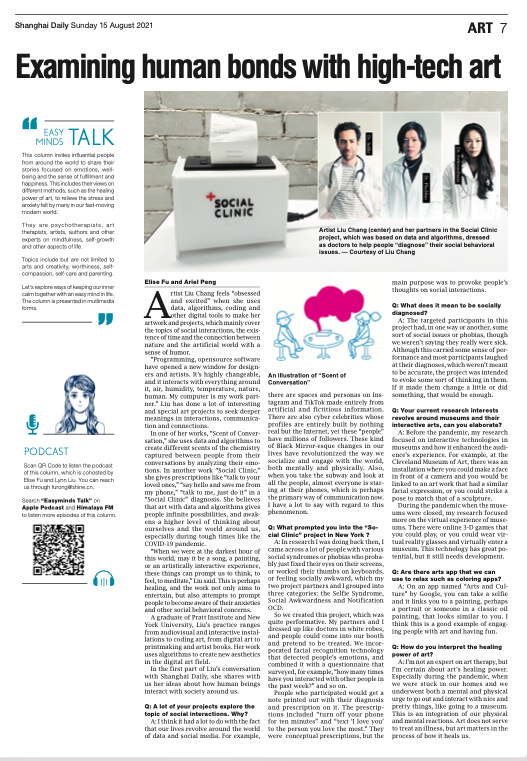
《社交诊所》是一个基于研究的艺术项目,由刘唱与Oryan Inbar、Ava Huang在纽约大学ITP共同发起,源自一门名为“计算与对话”的课程。它构想了一个介于真实与虚构之间的机构——通过人脸识别与在线问卷,诊断人们潜在的“社交症状”,并为这些“患者”提供一份解决方案。这些处方大多是一些对话的引子、一种互动的隐喻——它们是艺术家为社交困境开出的一剂剂“隐喻之药”。
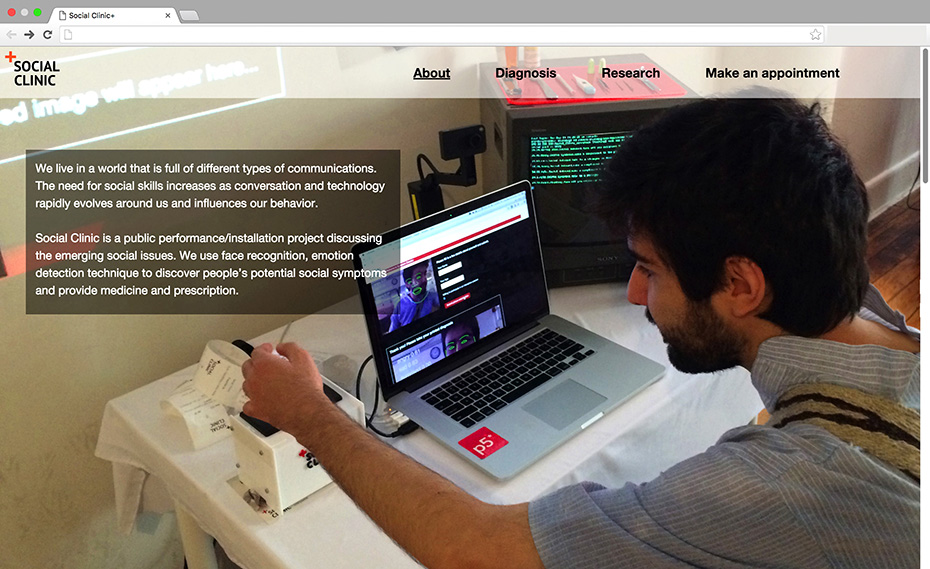
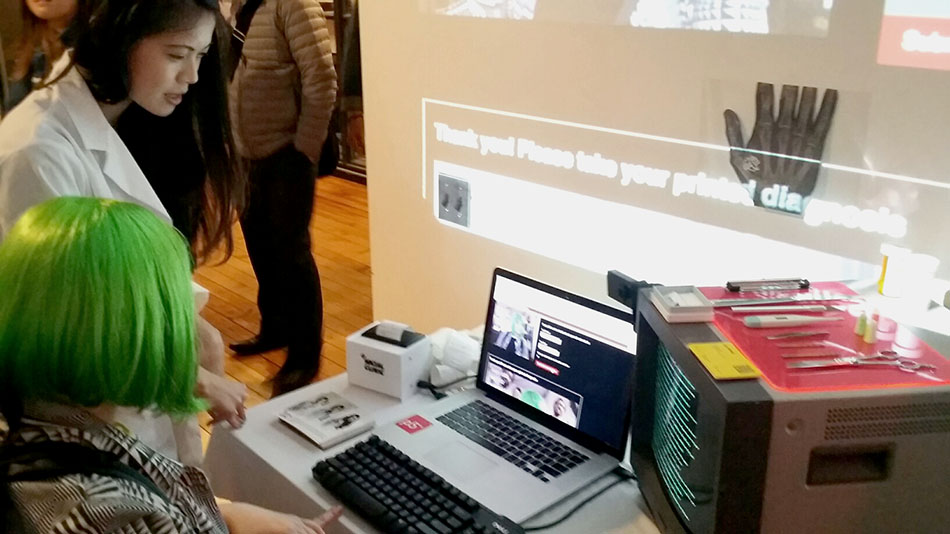
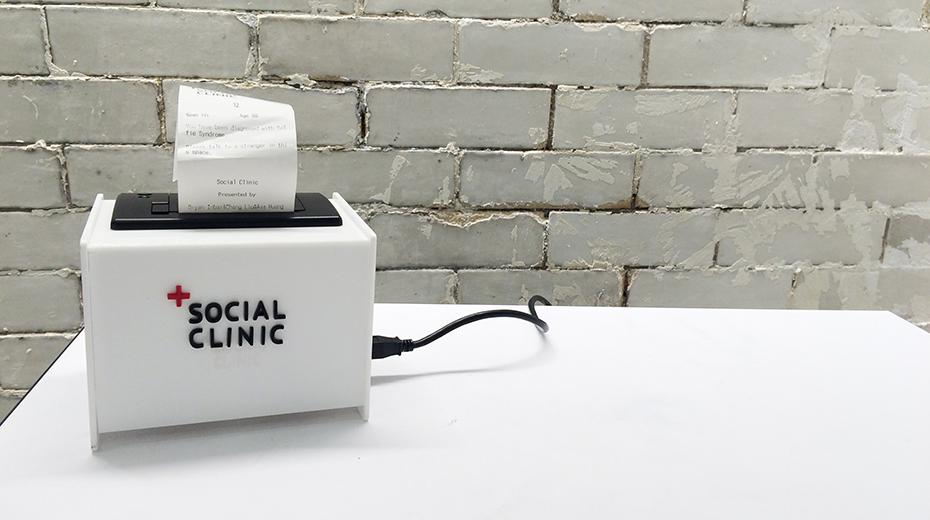
这是一个完整构建的系统:硬件上运用Arduino与热敏打印机,软件基于JavaScript、计算机视觉与Node.js,展台经由激光切割制作,甚至连诊所的标识与空间都由艺术家亲自设计。一切看似严谨,却是一场精心策划的虚构——它在真实的科技语言中植入荒诞,在严肃的医疗仪式中注入游戏。
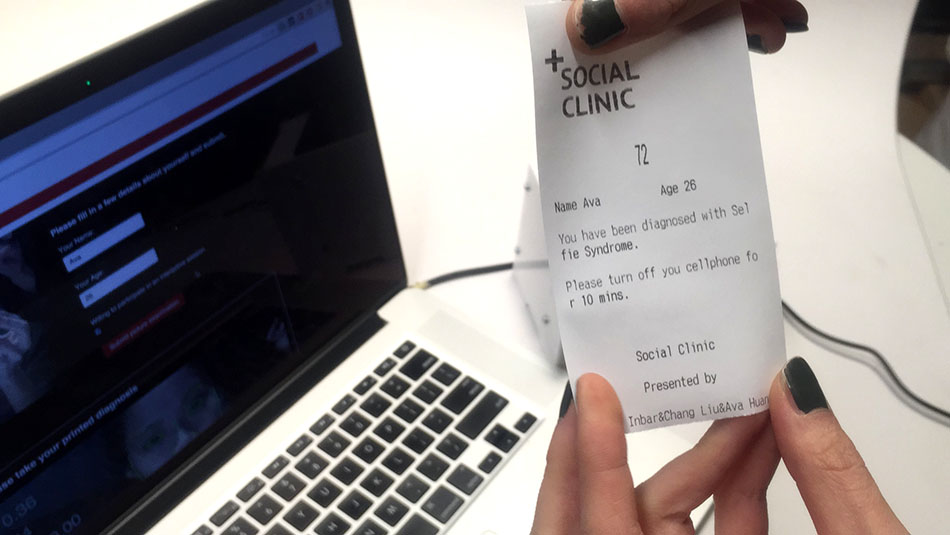
社交焦虑往往是一种难以言说的情绪——它潜伏在对话的间隙里,藏在手机屏幕亮起的瞬间,隐于聚会上无人交谈的角落。《社交诊所》通过一套模拟的医疗程序,将这些隐形的情绪外化、具象化。当你站在摄像头前,算法开始解读你的表情;当你填写问卷,系统分析你的社交状态。这不是人机对立的场景,而是一场人与机器共同完成的仪式——摄像头捕捉你的脸,算法给出回应,热敏打印机缓缓吐出你的“处方”。你明知这是一场虚构,却仍然愿意参与其中,因为机器给予你的,是一种被看见、被关注的体验。
在真正的医疗语境中,健康是生理的、量化的、可验证的。而《社交诊所》提供的是另一种可能性:用隐喻疗愈,用游戏缓解,用仪式安抚。它不声称自己能治愈任何人,但它提供了一个安全的空间——在这里,你的社交焦虑可以被命名、被写下、被打印出来、被握在手中。这种“外化”本身就是一种轻量的心理干预。在全民焦虑的时代,艺术是否可以成为一种非药物的“社会处方”?这是《社交诊所》留下的提问。
而最精妙的设计在于,整个过程始终带着一丝荒诞的幽默。热敏打印机吐出的“处方”上,可能写着“试着对陌生人微笑”或“今天不说‘对不起’”——这些看似无用的建议,恰恰因为其无用而让人会心一笑。严肃的医疗仪式与无厘头的处方内容之间形成的张力,让参与者在半信半疑中获得一种奇妙的释放。你未必真的被治愈了,但你笑了,你放松了,你愿意和身边的人讨论那张处方——这不正是社交的开始吗?
展览记录:
- Convohack,Baby Castle,纽约
- ITP春季展,纽约大学,2015
- Yami-Ichi互联网市集,纽约
媒体报道:
- 《纽约时报》(The New York Times)
- Hyperallergic
- 《上海日报》(Shanghai Daily)
Social Clinic
Performance, Performing Installation, Conceptual, Interactive
2015
We live in a world saturated with communication. As conversation and technology rapidly evolve around us—reshaping our behavior in subtle ways—the demand for social skills only intensifies. And with it, the shadow of social anxiety quietly spreads.
Social Clinic is a research-based project conceived by Liu Chang in collaboration with Oryan Inbar and Ava Huang at NYU-ITP, originating from a class titled "Computation and Conversation." It operates as an institution hovering between the real and the fictional: using facial recognition and online surveys to diagnose potential "social symptoms" in participants, then prescribing a "treatment." These prescriptions are largely conversation prompts, metaphors for interaction—a dose of "medicine" for social ailments.
The project is a fully realized system. Hardware incorporates Arduino and thermal printers; software runs on JavaScript, computer vision, and Node.js. The booth itself is laser-cut, and every detail—from the clinic's logo to its spatial design—was crafted by the artists. The result is a meticulously staged fiction: rigorous technological language infused with absurdity, the solemn ritual of medicine transformed into play.
Social anxiety often defies articulation—it lurks in the pauses between words, in the glow of a phone screen, in the corners of a party where no one stands. Social Clinic externalizes these invisible feelings through a simulated medical procedure. Stand before the camera, and an algorithm begins to read your expression. Complete a survey, and the system analyzes your social state. This is not a scenario of human versus machine, but a ritual performed by both together—the camera captures your face, the algorithm responds, the thermal printer slowly outputs your "prescription." You know it's a fiction, yet you participate willingly, because what the machine offers is the experience of being seen, of being attended to.
In clinical medicine, health is physiological, quantifiable, and verifiable. Social Clinic proposes an alternative: healing through metaphor, relief through play, comfort through ritual. It does not claim to cure anyone. But it provides a safe space where social anxiety can be named, written down, printed out, and held in your hand. This act of externalization is itself a form of gentle psychological intervention. In an age of collective anxiety, can art function as a non-pharmaceutical "social prescription"? This is the question Social Clinic leaves us with.
The project's most ingenious touch is its undercurrent of absurdist humor. The thermal printer's "prescriptions" might read: "Try smiling at a stranger today" or "Don't say 'sorry' for one hour." These seemingly useless suggestions elicit a knowing smile precisely because of their uselessness. The tension between the solemnity of medical ritual and the playfulness of the prescriptions creates a strange release. You may not actually be cured, but you laugh, you relax, you want to show your prescription to the person next to you—and isn't that where social connection begins?
Exhibitions:
- Convohack, Baby Castle, New York
- ITP Spring Show 2015, New York
- Yami-Ichi Internet Market, New York
Press:
- The New York Times
- Hyperallergic
- Shanghai Daily