Liu Chang: The Light of Small Things
刘唱:微物之光
刘唱:微物之光个展,否画廊,纽约
2018.7.14 - 2018.9.23
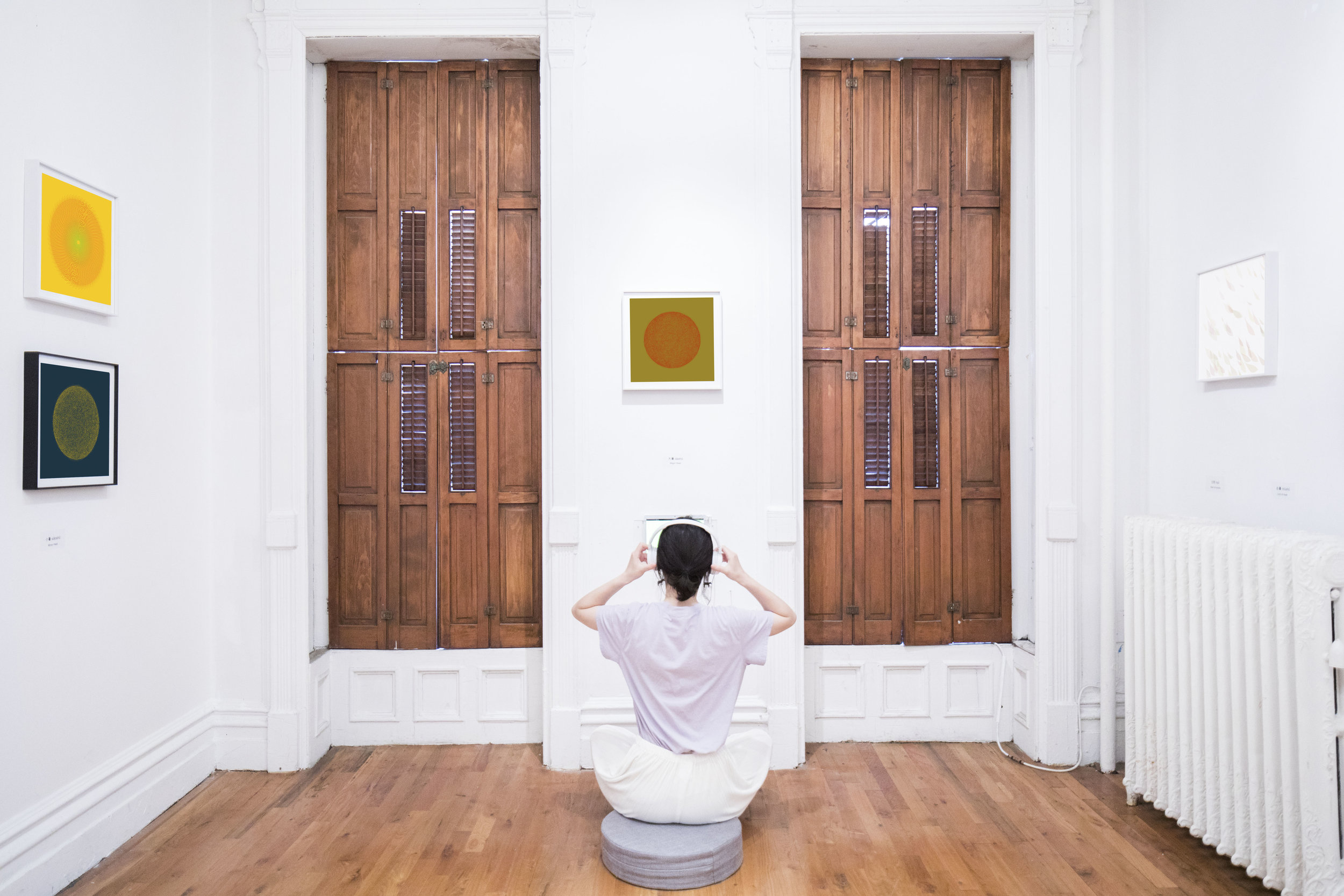
这是刘唱在纽约否画廊的第二次个展,呈现了她对“物”的边界的一次持续勘探。展览题目“微物之光”,取自细微之物所散发出的幽微光亮——那些容易被忽略的、正在发生的、缓慢变化的存在,在刘唱的作品中被凝视、被放大、被赋予形态。
展览汇聚了《自然之流》系列(包括基于二十四节气创作的数码微喷版画、温湿度感应版画、电脑生成动画)、与苗晶、Jason Hou合作的影像装置《博物柜:中药》,以及三本艺术家书——《几何书》《河流之书》《演化之书》。从自然界的物候,到手工制作的艺术家书,再到电脑绘制的生成图案,物的边界在刘唱的作品中一再模糊。在人工智能话题甚嚣尘上的当下,刘唱以农业文明时代传承的传统文化为灵感,以现代科技为手段呈现她的思考过程,而不是最终的答案。遐思其小如微物之光,其大若芥子须弥。
策展理念
本次展览的电子图录由何雨撰写文章,她在文中指出:
刘唱的工作始终在探寻一种“微妙的交互”——不是那种炫目的、即时的、技术炫耀式的互动,而是默默的、缓慢的、甚至无需触碰的交流。温度、湿度、触感,这些发生在周身的元素,每时每刻都在和我们发生关系,只是我们习焉不察。《微物之光》让这些隐形的关联变得可见:当版画随天气变化而改变面容,当节气在算法中流转成图案,当河流在手绘的书页间蜿蜒——物的边界模糊了,但世界的纹理,反而清晰起来。
展出作品
《自然之流》系列
电脑生成动画,数码微喷版画,温湿度感应版画
2018
二十四节气的制定,源于农耕社会对自然的依赖和对时间的理解。刘唱的《自然之流》系列利用电脑生成图像,通过代入每一个节气温度、湿度和风向等天气参数的历史极值,将二十四节气抽象化为一个个相互关联的编织图案——像从时间里抽取出的碎片,既包含着物候信息、文化元素,又融合了真实的气象数值。在未来收集更多年份的气象数据后,从每一年图案的微小变化中,可以看到气候变化的端倪和踪迹。
系列包括四件电脑生成动画,数字化的节气轮流出现,循环往复;二十四张版画作品则让节气凝结为静止的画面。其中《立春》《立夏》《立秋》《立冬》四幅为互动版画,与成都丝网版画工作室“解忧堂”合作完成。当外界湿度和温度发生变化时,版画上的图像会随之而变——感温、感水的颜料让画面拥有了呼吸。刘唱一直关注人、机器和自然的交互,而《自然之流》系列更纳入了时间维度,整组互动版画作品在一年四季完整循环后才能呈现全貌。
“我希望有一种交互是微妙的,不发声,不连电路,甚至不用去触摸。温度,湿度,触感,这些发生在周身的元素就是每时每刻和我们发生交互的部分。”
《博物柜:中药》
影像装置,与苗晶、Jason Hou合作
2018
这件影像装置如同一个中药柜,运行过程中不同的抽屉打开,有传统中药浮现——人参、苍耳子、冬虫夏草、枸杞、九香虫、麦冬、胖大海、牡蛎、石英等。作品营造一个沉浸式的体验空间,观众的视线流连于博物柜中,寻找开启的线索。
刘唱认为,中药反映了东西方文化根基中深层次的不同,也是她在中美两国生活经历文化冲击的一个外化:“中药是一种很玩味的东西,很神秘,融入很多除了科学、知识,还需要更多经验、能量在内的东西。一个中药老师傅在为你研制一包中草药的时候,似乎注入的不仅是各类化学的融合,却是一种莫名的相信?祈祷?心理作用?这种融合和混淆,是东方人如同打太极般的理解方式。”
艺术家书三卷
《几何书》是对二维和三维世界关系的思考。手绘与编程算法生成的二维基本图形,在风琴书的结构中获得了重新随机组合的可能性。书的形态本身,也成为几何游戏的一部分。
《河流之书一、二》是对地理边界的考察。刘唱研究了自己家乡所在的黄河,以及曾经居住地的河流——长江、苏州河、哈德逊河、弹子石等的流向和形态,勘绘出介于真实和想象之间的地图。两条长条形的手绘书,如同河流本身,绵延、蜿蜒、没有尽头。
《演化之书》则是对人类历史和文明演进的思考。灵感来源于《人类简史》中提到的两个埃塞俄比亚母亲——线粒体夏娃与智人母亲的隐喻,象征着所有现代人类的共同祖先。刘唱将这一意象转化为一本可以触摸的“人类之书”,每一页都是对演化痕迹的摹写与致敬。
现场回响
《典藏·Art Collection》刊登了展览评论《微物之光中的联系》,文中指出:
刘唱的工作始终在探寻那些被忽视的联结——人与机器、自然与算法、传统与未来、东方与西方。在《微物之光》中,这些联结变得愈发微妙,也愈发坚实。二十四节气的图案里,藏着气候的数据;中药柜的抽屉里,开着文化的裂隙;手绘的书页上,流着记忆的河。它们都是微物,却都散发着光。
《Yishu》杂志也刊发了对刘唱创作的专题介绍,将其置于当代艺术与科技融合的语境中加以讨论。
艺术家自述
时间这个本来就很抽象的概念,在没有这么多科技辅助工具之前,只是日升日落的昼夜交替以及季节变迁。对于农耕社会,时间就代表着在不同的时间做不同的事,按照自然之顺序和流动安排人类活动。
在这次的作品中,我希望有一种交互是默默的,微妙的,不发声,不连电路,甚至不用去触摸。温度,湿度,触感,这些发生在周身的元素就是每时每刻和我们发生交互的部分。当这些版画矗立于空间的时候,可能也每时每刻在和太阳月亮、水汽发生着关系,产生着变化,每一个季节,每一天的观者都能看到不一样的东西,哪怕是雨天和晴天。这个微妙的过程非常吸引我。
公共教育活动
展览期间,否画廊举办了多场公共教育活动:
- “都市农业工作坊”:参与者学习城市种植技巧,探索人与植物、人与食物的关系。
- “植物辨识”:在纽约的城市环境中辨认植物,重新连接被遗忘的自然感知。
- 主厨下午茶:根据展览作品创作的下午茶,让味觉也成为展览体验的一部分。
这些活动延续了展览的核心精神——让“微物之光”照进日常生活,让艺术体验不止于视觉,而是融入触觉、味觉、嗅觉,融入时间本身的流转。
展览画册
展览出版电子图录,可在否画廊网站阅读,包含何雨撰写的文章。
Liu Chang: The Light of Small Things
Solo Exhibition, Fou Gallery, New York
July 14 – September 23, 2018
The Light of Small Things marked Liu Chang's second solo exhibition at Fou Gallery, presenting a sustained exploration of the boundaries of "things." The exhibition title evokes the subtle glow emitted by minute presences—those easily overlooked, slowly transforming existences that Liu Chang's work magnifies, gazes upon, and renders into form.
The exhibition brought together The Flow of Nature series (including digital prints based on the twenty-four solar terms, temperature-and-humidity-responsive prints, and computer-generated animations), the video installation Cabinet of Chinese Medicine created in collaboration with Miao Jing and Jason Hou, and three artists' books: Geometry Book, River Book, and Evolution Book. From natural phenology to handmade artist's books to digitally generated patterns, the boundaries of "things" blur repeatedly in Liu Chang's work. In an era saturated with discourse on artificial intelligence, Liu draws inspiration from the traditional culture of agrarian civilization while employing modern technology as a means to present her process of thinking—not final answers, but open-ended inquiries. As the exhibition catalog suggests: "Thoughts, subtle as the light of small things, vast as a mustard seed containing Mount Sumeru."
Curatorial Vision
The exhibition's digital catalog features an essay by He Yu, who observes:
Liu Chang's practice consistently seeks a form of "subtle interaction"—not the flashy, instantaneous, technology-demonstrating kind, but a quiet, slow, even touchless communication. Temperature, humidity, tactility—these elements surrounding us every moment are constantly in dialogue with our being, yet we rarely notice. The Light of Small Things renders these invisible connections visible: prints that change with the weather, solar terms transformed into algorithmic patterns, rivers meandering across hand-drawn pages. The boundaries of things blur, but the texture of the world, in turn, becomes clearer.
Exhibited Works
The Flow of Nature Series
Computer-Generated Animations, Digital Prints, Temperature-and-Humidity-Responsive Prints
2018
The twenty-four solar terms originated from agrarian society's dependence on and desire to predict nature. Liu Chang's The Flow of Nature series employs computer-generated imagery, inputting historical extremes of temperature, humidity, and wind direction for each solar term to abstract them into interconnected woven patterns—fragments extracted from time, containing phenological information, cultural elements, and actual meteorological data. With the accumulation of more years of weather data in the future, the subtle variations in patterns from year to year will reveal traces of climate change.
The series includes four computer-generated animations where digitized solar terms appear in cyclical succession, and twenty-four prints that freeze each term into stillness. Among these, four interactive prints—Beginning of Spring, Beginning of Summer, Beginning of Autumn, and Beginning of Winter—were created in collaboration with Chengdu screenprint studio HappyTown. When ambient temperature or humidity shifts, the images on these prints transform accordingly: thermo-chromic and hydro-reactive pigments allow the surface to breathe. Liu Chang has long explored the interaction between humans, machines, and nature; The Flow of Nature incorporates time as an additional dimension, with the complete set of interactive prints revealing their full cycle only after a year has passed.
"I hope for an interaction that is subtle—no sound, no circuits, not even touch. Temperature, humidity, tactility—these elements surrounding us are constantly interacting with us, every moment."
Cabinet of Chinese Medicine
Video Installation, in collaboration with Miao Jing and Jason Hou
2018
This video installation resembles a traditional Chinese medicine cabinet. As it operates, different drawers open to reveal various herbs—ginseng, cocklebur fruit, cordyceps, goji berry, stink bug, dwarf lily turf, boat-fruited sterculia seed, oyster shell, quartz, among others. The work creates an immersive space where viewers' gazes wander across the cabinet, searching for clues to open.
Liu Chang sees Chinese medicine as reflecting big cultural differences between East and West, an externalization of the cultural shocks she experienced living between China and America: "Chinese medicine is fascinating, mysterious. It incorporates not only science and knowledge but also experience and energy. When an old TCM master prepares a prescription for you, it feels like more than chemical combinations—there's a kind of unspoken belief? Prayer? Psychology? This fusion and ambiguity is like the Eastern way of understanding, like playing Tai Chi."
Three Artist's Books
Geometry Book reflects on the relationship between two-dimensional and three-dimensional worlds. Hand-drawn and algorithmically generated basic geometric forms, within the structure of an accordion-fold book, open up new possibilities for random recombination. The book's very form becomes part of the geometric play.
River Book investigates geographical boundaries. Liu Chang studied the Yellow River near her hometown, as well as rivers alongside which she has lived—the Yangtze, Suzhou Creek, the Hudson, and Danzishi—tracing their currents and forms to chart a territory between reality and imagination. Two long, narrow hand-drawn books stretch like rivers themselves: meandering, endless.
Evolution Book contemplates the evolution of human history and civilization. Inspired by the two Ethiopian mothers mentioned in Sapiens: A Brief History of Humankind—metaphors for Mitochondrial Eve and the mother of all Homo sapiens, symbolizing the common ancestors of all modern humans—Liu transforms this concept into a tangible "book of humanity." Each page traces and pays homage to the marks of evolution.
Critical Response
Art Collection magazine published a review titled "The Connections Within the Light of Small Things," observing:
Liu Chang's work consistently seeks out overlooked connections—between humans and machines, nature and algorithm, tradition and future, East and West. In The Light of Small Things, these connections become increasingly subtle, yet increasingly solid. The patterns of the twenty-four solar terms contain climate data; the drawers of the medicine cabinet open onto cultural fissures; the pages of hand-drawn books flow with rivers of memory. They are all small things. Yet they all emit light.
Yishu magazine also featured Liu Chang's practice in the context of contemporary art and technology integration.
Artist Statement
Time, that abstract concept, before all these technological aids, was simply the alternation of day and night, the changing of seasons. For agrarian society, time meant doing different things at different times, arranging human activities according to nature's order and flow.
In this body of work, I hoped for an interaction that is quiet, subtle—no sound, no circuits, not even touch. Temperature, humidity, tactility—these elements surrounding us are constantly interacting with us, every moment. When these prints stand in a space, they are constantly in dialogue with the sun and moon, with moisture in the air, constantly changing. Viewers in different seasons, on different days, will see something different—even rainy versus sunny days. This subtle process fascinates me.
Public Programs
During the exhibition, Fou Gallery hosted several public events:
- Urban Agriculture Workshop: Participants learned urban planting techniques, exploring relationships between humans, plants, and food.
- Plant Identification Walk: Identifying plants within New York's urban environment, reconnecting with forgotten natural perception.
- Curated Afternoon Tea: A chef-created tea experience inspired by the exhibited works, engaging taste as part of the exhibition experience.
These programs extended the exhibition's core spirit—allowing "the light of small things" to illuminate daily life, making the art experience extend beyond vision into touch, taste, smell, and the very flow of time itself.
Exhibition Catalog
A digital exhibition catalog, including an essay by He Yu, is available on the Fou Gallery website.